Camel Routes as AI Tools: Unified Tooling and MCP Server in Camel 4.22
Co-authored with Federico Mariani and Jiri Ondrusek. Originally published on the Apache Camel blog.
Camel 4.22 brings two features that change how Camel integrates with AI: a unified tool abstraction (camel-ai-tool) and a built-in MCP server (camel-mcp-server). Together, they let you turn any Camel route into an AI tool that works across frameworks and protocols.
This post covers both features.
The Problem: Fragmented Tool Definitions
Before 4.22, defining AI tools in Camel meant picking a framework and committing to it. Want to expose a route as a tool for LangChain4j? Use camel-langchain4j-tools. For Spring AI? Use camel-spring-ai-tools. Each had its own consumer, its own registry, its own way of describing parameters.
This created three problems:
- Duplication. The same tool logic had to be defined twice if you wanted it available to both LangChain4j and Spring AI.
- Lock-in. Switching AI frameworks meant rewriting your tool definitions.
- No external access. External AI agents could not discover or call your tools.
The Solution: camel-ai-tool
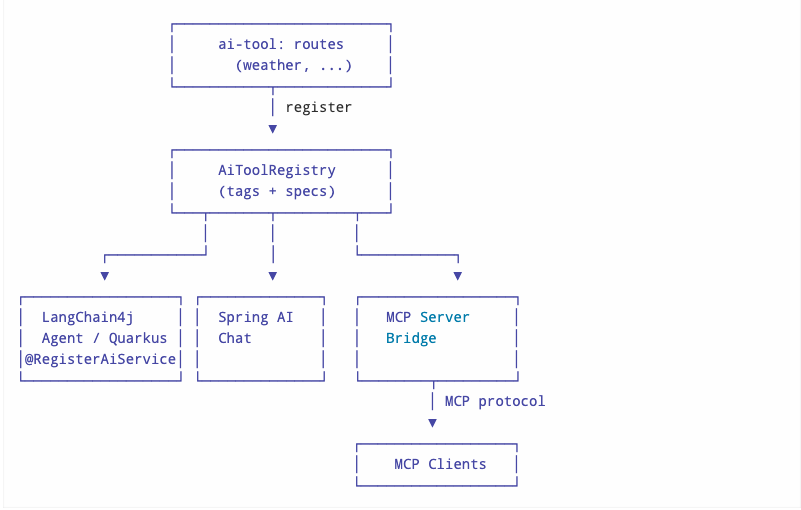
The new camel-ai-tool component solves the first two problems. You define a tool once. Every AI framework sees it.
                  ┌─────────────────────────┐
                  │     ai-tool: routes     │
                  │       (weather, ...)    │
                  └───────────┬─────────────┘
                              │ register
                              ▼
                  ┌─────────────────────────┐
                  │     AiToolRegistry      │
                  │     (tags + specs)      │
                  └───┬───────┬─────────┬───┘
                      │       │         │
          ┌───────────┘       │         └───────────┐
          ▼                   ▼                     ▼
┌──────────────────┐ ┌──────────────┐   ┌──────────────────┐
│  LangChain4j     │ │  Spring AI   │   │   MCP Server     │
│  Agent / Quarkus │ │  Chat        │   │   Bridge         │
│@RegisterAiService│ │              │   │                  │
└──────────────────┘ └──────────────┘   └────────┬─────────┘
                                                 │ MCP protocol
                                                 ▼
                                        ┌──────────────────┐
                                        │    MCP Clients   │
                                        └──────────────────┘
Define Once, Use Everywhere
A tool is just a Camel route with an ai-tool: consumer:
- route:
    from:
      uri: ai-tool:weather
      parameters:
        tags: weather
        description: "Get current weather for a city"
        parameter.city: string
        parameter.city.description: "The city name"
    steps:
      - to:
          uri: bean:weatherService
That route is now registered in the AiToolRegistry with its name (weather), description, parameter schema, and tags. No framework-specific code. No annotations.
Framework Bridges
When an AI producer starts, it queries the AiToolRegistry for tools matching its configured tags. Framework-specific bridges handle the translation:
- LangChain4j Agent reads from the registry and converts each
AiToolSpecinto a LangChain4jToolSpecification. - Spring AI Chat does the same, converting to Spring AI's
FunctionCallback.
The same weather tool works with both. Switch your AI producer from LangChain4j to Spring AI. Your tools don't change.
Quarkus AIService Integration
On Quarkus, the integration goes one step further. If camel-quarkus-ai-tool and quarkus-langchain4j are both on the classpath, Camel tools are automatically available to any @RegisterAiService interface. No Camel producer route needed:
@RegisterAiService
@CamelAiTools("weather")
public interface WeatherAgent {
    String chat(@UserMessage String question);
}
The @CamelAiTools annotation filters which Camel tools the AI service can see, using the same tag mechanism as the Camel producers. Without the annotation, the service sees all registered tools:
@RegisterAiService
@CamelAiTools("support")
public interface SupportAgent {
    String chat(@UserMessage String question);
}

@RegisterAiService
public interface GeneralAgent {
    // sees all ai-tool routes, regardless of tags
    String chat(@UserMessage String question);
}
This bridges Camel's tool registry directly into the Quarkus LangChain4j ToolProvider SPI at build time. No manual wiring, no runtime reflection.
Tags for Organization
Tags group tools into logical sets. An AI producer selects tools by tag:
- route:
    from:
      uri: langchain4j-agent:myAgent
      parameters:
        tags: orders,inventory
This agent sees only tools tagged orders or inventory. Tools tagged admin or left untagged are not visible. Tags are the mechanism for controlling which tools are exposed to which agents.
Migration
camel-langchain4j-tools is deprecated in 4.22. camel-spring-ai-tools has been removed. If you have existing tool routes using these components, the migration is straightforward: replace langchain4j-tools:myTool with ai-tool:myTool and add a tags parameter. The route body stays the same.
The Next Level: camel-mcp-server
Unified tooling solves the internal problem. But what about external AI agents? That is where MCP comes in.
The Model Context Protocol (MCP) is an open standard for connecting AI models to external tools and data sources. IDE assistants like Claude Desktop, Cursor, and Windsurf support it. So do AI frameworks like LangChain4j, OpenAI, Spring AI, and Quarkus LangChain4j @RegisterAiService. With camel-mcp-server, your Camel routes become MCP tools that any MCP-compatible client can discover and call.
How It Works
The McpServerBridge is a CamelContext service that watches the AiToolRegistry. When a route with an ai-tool: consumer starts, the bridge picks it up and exposes it as an MCP tool. When a route stops, the tool is removed and connected clients are notified via tools/list_changed.
The bridge selects tools by tag. You configure which tags to expose to MCP clients:
camel.server.mcp.tags=orders,inventory
Only tools matching those tags are visible over MCP. Untagged tools and tools with other tags are never exposed. This is a security boundary: external MCP clients are untrusted senders, so you control exactly which tools they can see.
Architecture
Two modules work together:
camel-mcp-server-apicontains theMcpServerBridge, theMcpServerEngineSPI, and a conformance test kit. It has no dependency on any specific HTTP server.camel-mcp-serverprovides a Vert.x-based engine for Camel Main and JBang, built on top of the MCP Java SDK.
The SPI design follows the same pattern as Camel's PlatformHttpEngine. Each runtime provides its own engine backed by its native MCP stack:
┌───────────────────┐ ┌────────────────────────┐ ┌───────────────────┐
│  camel-mcp-server │ │camel-quarkus-mcp-server│ │camel-mcp-server-  │
│   (Main / JBang)  │ │      (Quarkus)         │ │  starter (Boot)   │
│                   │ │                        │ │                   │
│  Vert.x engine    │ │  quarkus-mcp-server    │ │  Spring AI MCP    │
│  + MCP Java SDK   │ │  + ToolManager API     │ │  server           │
└─────────┬─────────┘ └───────────┬────────────┘ └─────────┬─────────┘
          │                       │                        │
          └───────────────────────┼────────────────────────┘
                                  │
                    ┌─────────────┴─────────────┐
                    │    camel-mcp-server-api   │
                    │  (McpServerBridge + SPI)  │
                    └───────────────────────────┘
- Camel Quarkus uses the Quarkus MCP server extension and its programmatic
ToolManagerAPI. The MCP Java SDK and Reactor never reach the classpath. - Camel Spring Boot uses the Spring AI MCP server. Camel tools coexist with Spring AI's native
@McpToolbeans on the same server. - Camel Main / JBang uses the Vert.x-based engine from
camel-mcp-server, built on top of the MCP Java SDK.
Runtime Configuration
Each runtime uses its own property namespace for the Camel MCP bridge, and delegates serving concerns (path, transport, auth) to its native MCP stack.
Camel Main / JBang
# Camel bridge
camel.server.mcp.tags=weather
camel.server.mcp.tool-timeout=20000
Serving is handled by the built-in Vert.x engine on the platform HTTP port.
Quarkus
# Camel bridge
quarkus.camel.mcp-server.tags=weather
quarkus.camel.mcp-server.tool-timeout=10000

# Serving (quarkus-mcp-server)
quarkus.mcp.server.server-info.name=my-integration-app
quarkus.mcp.server.server-info.version=1.0.0
quarkus.mcp.server.http.root-path=/mcp
Quarkus uses the quarkus-mcp-server extension. Quarkus-annotated @Tool beans and Camel ai-tool routes coexist on the same MCP server. Native compilation works out of the box.
Spring Boot
# Camel bridge
camel.mcp-server.tags=weather
camel.mcp-server.tool-timeout=10000

# Serving (Spring AI MCP Server)
spring.ai.mcp.server.protocol=STREAMABLE
spring.ai.mcp.server.name=my-integration-app
spring.ai.mcp.server.version=1.0.0
spring.ai.mcp.server.streamable-http.mcp-endpoint=/mcp
Spring Boot uses the Spring AI MCP server. Set spring.ai.mcp.server.protocol=STREAMABLE explicitly for streamable HTTP transport. Without it, the auto-configuration falls back to the deprecated SSE transport. Spring AI's @McpTool beans and Camel ai-tool routes coexist on the same server.
For stdio transport (useful for Claude Desktop and similar desktop MCP clients), swap to spring-ai-starter-mcp-server (without webmvc) and configure:
spring.ai.mcp.server.stdio=true
spring.main.web-application-type=none
logging.threshold.console=OFF
The Quarkus equivalent uses quarkus.mcp.server."<default>".http.enabled=false to disable the HTTP transport.
Security Built In
The bridge enforces several security rules:
- Error sanitization. Raw route exception messages never reach the MCP client. Errors are wrapped in a safe format.
- Timeout protection. Each tool call has a bounded execution timeout.
- Name collision detection. If two tools share the same name, the bridge refuses to register the duplicate and logs an error.
End-to-End Example
Here is a complete setup: a Camel route defined as an AI tool, exposed to both a LangChain4j agent and MCP clients in the same application.
- route:
    from:
      uri: ai-tool:weather
      parameters:
        tags: weather
        description: "Get current weather for a city"
        parameter.city: string
        parameter.city.description: "The city name"
    steps:
      - to:
          uri: bean:weatherService

# LangChain4j agent using weather tools
- route:
    from:
      uri: direct:askAgent
    steps:
      - to:
          uri: langchain4j-agent:assistant?tags=weather
Expose the weather tool to MCP clients using the property matching your runtime:
# Camel Main / JBang
camel.server.mcp.tags=weather

# Quarkus
quarkus.camel.mcp-server.tags=weather

# Spring Boot
camel.mcp-server.tags=weather
With this setup:
- The
langchain4j-agentproducer discovers theweathertool via theAiToolRegistryand uses it to answer questions. - Any MCP client connecting to the application discovers the same tool via the MCP protocol and can call it over MCP.
- The tool is defined once. No duplication. No framework-specific code.
Connect any MCP client to this server, and it can check the weather through the same Camel route your LangChain4j agent uses.
Try It
All of these features ship in Apache Camel 4.22. The camel-ai-tool and camel-mcp-server components work with Camel Main, JBang, Quarkus, and Spring Boot.
To get started:
- Add
camel-ai-toolto your dependencies and define your tools asai-tool:routes with tags and descriptions. - Use them from a Camel AI producer (
langchain4j-agent,spring-ai-chat), from a Quarkus@RegisterAiServicewith@CamelAiTools, or both. - To expose tools over MCP, add your runtime's MCP server dependency (
camel-mcp-serverfor Main/JBang,camel-quarkus-mcp-serverfor Quarkus, orcamel-mcp-server-starterfor Spring Boot) and configure the MCP tags (see Runtime Configuration above).
Your Camel routes are now AI tools. Define once, use everywhere, serve to any agent.